Showing posts with label Bonfrere. Show all posts

Tuesday, October 10, 2006

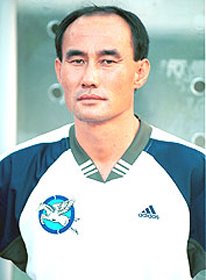
Kim Hak-Bom: Coach Of Korea's Winning Machine

Kim Hak-bom
In Korean, ‘Chunma’ is a Pegasus - the creature that in Greek legend had the ability to fly above the rest of the herd. Seongnam Ilwha Chunma has been doing just that in the K-League since 1993 when the team won the first of, to date, six titles.

The air may be thinner at the top, but the pressure to maintain high standards is intense and unyielding.

"There's a lot of pressure," Head Coach Kim Hak-bom told Soccerphile. "Our goal is always to win the championship and other competitions too. Just maintaining our position as one of the top teams is tough by itself."

It may be tough at the top, but that is where Seongnam is and plans to stay. The last league trophy resided in the trophy cabinet just to the south of Seoul in 2003. Kim took over at the beginning of 2005 and in the first half of 2006 he steered the team to the K-League first stage title -- by a margin of ten points -- earning a place in the end of season championship playoffs.

Even after such a statement of superiority, Seongnam was busy in the summer. US$1 million was enough to tempt ex-Romanian international striker Adrian Naega from Chunnam Dragons to link up with a strike force that is already one of the strongest among the league's 14 teams.

An added bonus to Naega's undoubted predatory skills was the fact, apart from his European experience, that he had already spent a year in Korea. According to Kim, buying players is a lottery.

"The chance of success is 50-50," the 46 year-old says. "Brazilians have mild characters and are good buys. They are technically very good. On the whole, good European players won't come to Korea but in Brazil they have two groups of players -- one goes to Europe, the others go to other countries."

"Sometimes I can find players in China or Southeast Asia but their level is not so high; we can find these types of players in Korea too. In China and Southeast Asia the players are a little expensive and they are a little lazy."

In this increasing age of globalization, coaches across the world are faced with the problem of blending players of different nationalities into a coherent and hard-working team. Kim has an advantage in the particularly potent brand of firewater that all Koreans know and not a few love.

"Soju is one way!" He laughs and adds, "With Soju they can talk heart to heart."

Perhaps the rice-based spirit could be made freely available in the stadium to tempt fans to the small stadium near Bundang station. Seongnam may be the country's most successful team, but they also attract the lowest crowds.

The team, Ilhwa Chunma, moved to Seongnam from Chonan in 2000 and it wasn't warmly welcomed by the sizeable Christian population in the city. The protestors objected to the fact that the club is owned by the controversial Unification Church. The church was founded by Reverend Moon Sung-myong, a name that gave rise to the nickname, widely used in the Western press, of "The Moonies".

Kim cares only about his team but is at a loss to explain why Seongnam have few followers.

"I just don't know," he says as he lights a cigarette. "As a coach, I am not happy with the situation. We do well but the fans don't come. It could be religious reasons or regional reasons, In the K-League, the regional feeling is weak. Seongnam people have no feeling for their city team.

"All we can do is play and perform well and then the supporters will know that and hopefully come back. The club officials are always trying to think of ways to attract fans. I hope to be like Manchester United where the tickets are already sold out."

Kim has been in the job around 18 months but before he answered Seongnam's call, he spent two years sitting on the Korean Football Association's Technical Committee, the body that is responsible for the national team.

The coach believes that the team over-achieved in 2002 and its natural level is just between the first and second rounds.

"It wasn't bad," he says "but we could have done better. The formation of the team was too defensive. Everyone agrees with this, including professional analysts, the media and the fans. Against Togo ... we should have been more attacking; they were a man down. If we have one more goal then we have a much better chance of reaching the second round."

"Look at Hiddink; did you think that Korea would beat Italy? But he said that 'this is Korea so we have no problem.' Advocaat is a top-class coach but he needed a big goal and then needed to develop a plan towards that. Hiddink did so and gave the players leadership and confidence to do so. Advocaat didn't."

Despite his criticisms of Advocaat, Kim holds the Dutchman in high regard, unlike his two predecessors Humberto Coelho and Jo Bonfrere. He urged the new coach, Pim Verbeek, to watch as many Korean games as possible in a bid to find the stars of the future.

"I was a member of the KFA technical committee with Coelho and Bonfrere. They used to say that there are no players in Korea. We said 'Hey, you are supposed to be high-level coaches. You say there are no players?' At the time we said to them 'we pay you lots of money to find players, you have to look.'"

With his national team experience, if Kim can achieve consistent success with Seongnam, then he could become a prime candidate for the national coaching job.

"It's good to learn from skilful foreign coaches. Someday Korean coaches have to take a role in the national team. It's hard to say if I will do but if a Korean person has experience and skill then they should have the opportunity."


Copyright: John Duerden & Soccerphile.com

K-League News and Interviews

Tuesday, March 14, 2006

Korea Pre-Match Press Conference

It has become almost a ritual now in South Korea that whenever the national team prepares for a home game, the day before kick-off, dozens of journalists converge on a prestigious hotel in north-western Seoul and spend over half an hour grilling the players.

The squad sits on different round tables. The more famous the player, the more chance they have of getting a table to themselves with chairs left empty in anticipation of journalistic attention. Other players, some less well-known or simply less talkative and outgoing, will sit with team-mates and roll eyes at questions or laugh at each other’s jokes.

It is Dick Advocaat’s idea, the Dutchman immediately winning over the scores of scribes in Korea by throwing open the doors, or more accurately, tearing down the barriers that had often existed between players and press under predecessor Jo Bonfrere – a seemingly small gesture but, unsurprisingly, a popular one.

On this occasion, the fourth time it has happened, the players are preparing for a friendly game with Angola the following day. Most of the squad have just returned from a six week overseas tour – a punishing itinerary that consisted of ten games, a good deal of training and by the looks of things, some significant bonding – as the players seem more relaxed in each other’s and the press’s presence than in the past.

Two foreign-based players are also holding court. Lee Eul-yong of Trabszonspor and Tottenham’s Lee Young-pyo. Due to the Carling Cup final, Park Ji-sung arrived late.

lee-young-pyoThe Spurs star is one of two players that have the ‘honour’ of an advertising board being placed behind him, the other is Lee Chun-soo, Ulsan Hyundai Horang-I’s tricky winger and K-League MVP 2005.

The atmosphere is busy but fairly relaxed. Advocaat, like the rest of his coaching staff, stands to one side, watching proceedings, helping himself to orange juice and shouting comments to players and pressmen. The Dutchman tells reporters interviewing young midfielder Baek Ji-hoon that it is his birthday.

Abruptly, the players get up and leave. Usually they head back gratefully to hotel rooms but this time they file into the main press conference room to participate in some kind of sponsorship deal between the national team, Amway and some kind of nutrient bar – one that looks strange enough not to warrant a taste.

After a gratifyingly short period of time, the press conference begins. Such affairs are not usually as interesting as one may think. The coach makes a statement, reporters ask questions which are usually greeted with fairly predictable answers.

Still, there is always the chance of something shocking, insightful or newsworthy and with the World Cup 100 days away and the national team’s last friendly game in Korea before the tournament just a day away, everybody is here.

Unsurprisingly, the theme of the conference was the overseas tour and preparations for the World Cup. Advocaat explained why the trip had been a success, the different kind of players played, the different kind of teams played and the different kind of systems played.

“We have a very good feeling about the past five or six weeks – playing and travelling with the team… we took the risk of playing ten games in five weeks to give the players a chance to play abroad against good countries,” said the Dutchman.

“Normally as coaches we wouldn’t play so many games… we had some great results and the games we lost we could have won. It was good experience. When Lee Young- pyo arrived in training he said that he could see the difference between now and November. We have improved a lot.”

Subsequently, a number of questions are asked, the one that gets a reaction from the coach is one that goes along the lines of: “You played a new four-man defence on the tour, most games Choi Jin-cheul and Kim Jin-kyu were the centre backs. Even though this pair continued to make mistakes, you didn’t give anybody else much of a chance. Why was that?”

Being sat on the front row, it was easy to see that even before the question had been fully translated to Advocaat, his face became flushed with anger and his eyes became hard. He struggled to contain himself.

“I make the decisions,” he barked. “Journalists write. You can write about it.”

It was interesting that Advocaat refused to comment on particular players but he followed the example set by his assistant Pim Verbeek a few months earlier, being happy to talk about young striker Park Chu-young, who according to the Korean media was going through a slump.

“We have to find out if Park will be in the eleven - it’s up to him. Of course, we take the decisions but when he shows his qualities then he will play – if he brings the right quality. Probably Park has to bring a little bit more.”

“It’s too early to say what the squad will be, there is still three months – everything is open. We will see the K-League and we can see many players abroad and see how they’re doing. We will tell the players to keep their good form for their clubs or it will be dangerous for them.”

That was pretty much it.

World Cup Tickets

Tuesday, July 26, 2005

South Korea's Dynamic Duo

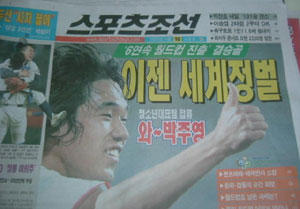
It’s a pretty good time to be a Korean football fan. Qualification for the World Cup was expected but still welcome for all concerned. But what is really getting people excited are the ‘Two Parks’ – Park Ji-sung and Park Chu-young.– the hottest properties in Asian football.
Park ji-sung

The older of the two, Ji-sung, has just joined Manchester United in a $7.4 million deal; one that thrusts the shy Suwon native stumbling onto one of the brightest stages on the planet.

Manchester United is the biggest and richest sports franchise in the world, have fans from Auckland to Argentina, have lifted the English title eight times in the past thirteen years and have young players like Wayne Rooney and Cristiano Ronaldo and will be challenging for titles at home and abroad for years to come.

The 24 year-old will need to use all of his, not inconsiderable, experience in England. He took the unusual route of moving to Japan without ever appearing in the Korean league. His two years at Kyoto Purple Sanga were successful ones but they weren’t the reason why the midfielder earned a move to Dutch giants PSV Eindhoven.

Ji-sung’s exploits in South Korea’s run to the semi-finals in the 2002 World Cup were the clincher to his European move as was his relationship with then Korean boss Guus Hiddink. When Park scored an exquisite goal against Portugal in Incheon, he ran straight to the Dutchman and jumped into his arms.

Hiddink has since been reluctant to let go and when he took over the reins at Eindhoven he wasted no time in persuading Park to join him and despite some initial settling-in problems, the Korean established himself as an integral part of the midfield in southern Holland, leading the team to the semi-finals of the UEFA Champions League.

Such performances inevitably attracted the attention of bigger fish and they don’t come any bigger than Manchester United. It’s difficult for any player to turn down the “Red Devils” and Park will soon become the first South Korean to play in the Premier League.

Equally inevitable were suggestions in the English and European media that United bought Park to ‘crack’ the Asian market – to help boost the focus of the club’s smooth merchandising machine in the east.

The biggest service the star, for a star he now is, can provide to the Asian game during his time at United is to prove that European clubs can actually sign Far Eastern players for their talent and skill and not for the dubious perceived benefits of selling shirts in the Orient.

It won’t be easy, as he has to break into the first eleven in England and stay there but playing with stars like Rooney and Ronaldo can only help the Asian develop.
“What is important for me is whether I can play in games or not,’’ Park, who is planning to study English, said in a press conference.
``I don’t think I will become a big star like David Beckham right now,” joked the Korean about the former Manchester player. “Maybe I can if I was that handsome, but I am always trying to be a better player, so I don’t think it is impossible to become a player like Beckham.’’
Such humor will serve him well as will his typical Korean determination to succeed. English fans prize effort, heart and willingness to give everything for the team above everything, qualities that Park has in abundance as well as no little skill.

If the elder Park is Batman then Chu-young is certainly the boy wonder and plans to follow the trail blazed by the United man, repeatedly stating his desire to play in England. With the meteoric rise of the player, who turned 20 on July 10, few would bet against the sensation doing just that.
Park Chu-young

To anyone living in north-east Asia, it is scarcely believable that the Daegu native was unknown just a year ago. The striker’s six goals during last November’s Asian Youth Championship, won the title for his team and the prize of MVP for himself.

The greater award of the AFC’s Young Asian Player of 2004 title was received in January 2005 as was attention from a host of K-League clubs with FC Seoul eventually capturing the services of the emerging celebrity.

Encouragingly for Park and for South Korea, he seems to be able to make the step up to the next level with breathtaking effortlessness. He finished the pre-season Hauzen Cup competition as joint top scorer and then went one better by becoming the outright leading marksman in the first stage of the K-League, despite missing five games due to international duty. His mere presence tempts the sometimes reluctant Korean public to pour into stadiums all over the republic.

If observers didn’t believe the hype, they had to reconsider in June. After only three appearances in the K-League, national coach Jo Bonfrere bowed to media pressure and included the deeply- religious goalgetter in the starting line-ups for the vital World Cup Qualifiers in Uzbekistan and Kuwait.

A last minute equalizer in Tashkent kept his country on the road to Germany 2006 and five days later, the striker scored the first goal in a sweltering Kuwait City and earned the penalty for the second to secure the win that guaranteed South Korea a place in a seventh World Cup.

Rarely has a rise been so dramatic but the ambitious and single-minded 20 year-old doesn’t plan to stop anytime in the near future as his avowed intent is to move to England as soon as possible.
South Korea just may have a pair of global stars on its hands